A real mystery person was the talk of the town of Cleveland from 1892 to 1895. In these three years the woman made enough appearances to have a group of loyal supporters. And at the end of the period, when all of the cards were down, there was a surprise ending. That she was a mysterious woman there was no doubt. When she appeared at dusk or close to midnight, she awore [wore] a long black dress. But she had a fetish/tradition of being partial to men’s yellow working gloves. Her last appearance was in September 1892 was a very frightening appearance for three young ladies, and it was whispered around for months before her second appearance in March 1893. Her appearance was last appearance was almost forgotten, but she appeared last Sunday evening to a young couple walking home from services at the Cumberland Presbyterian Church. The same mysterious character appeared at the corner of South and Church streets. The young man suddenly discovered that someone was immediately behind him, and in fact she was trampling on his heels. Looking back over his shoulder he was terribly frightened to find that she was in close proximity with the “Woman In Black.”
The young lady also discovered the remarkable personage and was horrified. The couple quickened their pace but was still closely followed by their tormentor. Finally, the young people stopped and requested the “Woman In Black” to go in front, which she unhesitatingly did, and for four blocks she remained just in front of the terror-stricken youngsters. Gid, the young man, acknowledged that he was never as badly frightened, but said that had it not been that he was very weak from a recent illness he would have become better acquainted with the “Woman In Black.”
The second visit by the mystery woman was reported in March 1893. A few months ago some of the citizens of East Cleveland were very much annoyed and frightened by being followed by some mysterious individual heavily draped in black. Several nights diligent search was made by parties determined to capture the “Woman In Black” and solve the mystery, but all in vain, and in a few nights she would again appear when least expected.
One thing is curious about this legendary person. She was seen and heard about in the columns of the Cleveland Weekly Herald. Perhaps this group of readers was more observant or watchful for the woman of mystery.
In March 1893 a brief note was addressed to “that young chap who is disguising himself in female attire, and parading the streets every Sunday night frightening women and children, and who is destined to commonly known as the ‘Woman In Black,’ and who is destined to meet with ‘an accident’ if he persists in such conduct.”
A compliment was sent her way when the editor wrote: “If that ‘Woman in Black’ don’t look sharp the city marshal will catch her.”
(Cleveland Herald 6 April 1893)
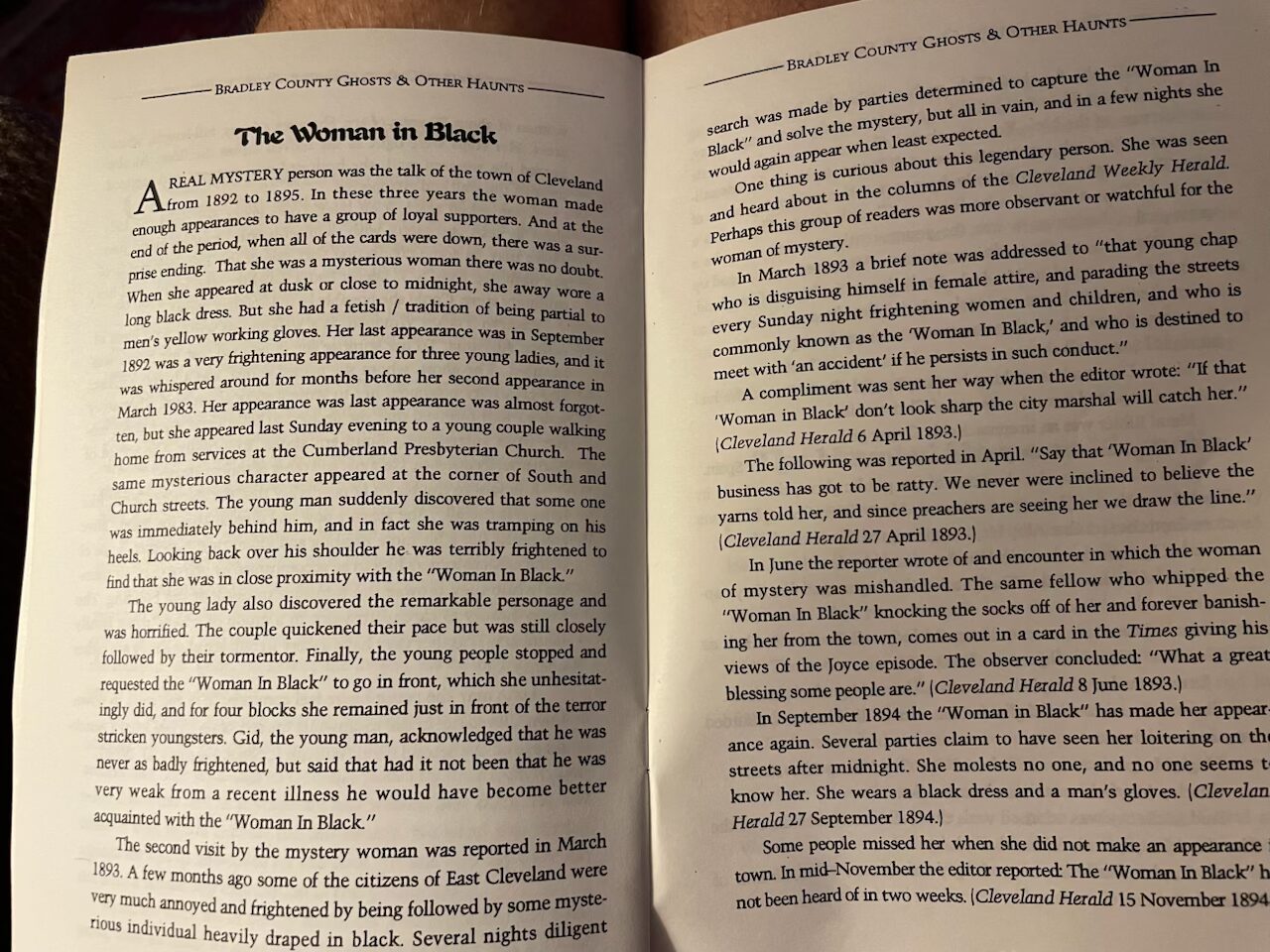
The following was reported in April. “Say that ‘Woman In Black’ business has got to be ratty. We never were inclined to believe the yarns told her, and since preachers are seeing her we draw the line.”
(Cleveland Herald 27 April 1893)
In June the reporter wrote of and encounter in which the woman of mystery was mishandled. The same fellow who whipped the “Woman In Black” knocking the socks off of her and forever banishing her from the town, comes out in a card in the Times giving his views of the Joyce episode. The observer concluded: “What a great blessing some people are.”
(Cleveland Herald 8 June 1893)
In September 1894 the “Woman In Black” has made her appearance again. Several parties claim to have seen her loitering on the streets after midnight. She molests no one, and no one seems to know her. She wears a black dress and a man’s gloves.
(Cleveland Herald 27 September 1894)
Some people missed her when she did not make an appearance in town. In mid-November the editor reported: “The ‘Woman In Black’ has not been heard of in two weeks.”
(Cleveland Herald 15 November 1894*)
In 1895, the Rosebud Club, with membership limited to young ladies and men, they decided to have a masquerade party on Monday. In February of the New Year, the theme of the party was the “Maritime Company” which represented many different styles and nationalities. The members appropriately dress[ed] at the residence/house of Dr. S. H. Day, a dentist, who lived on Church Street. There was a great deal of hesitation when the young gentleman was to name the “correct guess” and choose his companion. After they were paired up the group proceeded to Mr. J. A. Paul’s house in North Cleveland, where the “golden hours on angels’ wings,” flew by or so it seemed to the happy guests. Many of the costumes were picturesque and beautiful, and all were well chosen.
Mattie Day made a striking Norwegian girl. One fancied she had just been imported from the streets of Christiania. Maud Kibler was an irreproachable Gypsy girl. Blanch Jordan was in the picturesque dress of the Flower girl of Spain. Edna Bazemore in the character of our public ghost, the “Lady in Black,” struck the observers with awe.
Many funny complications arose from the fact that Alby Hayes represented the same character. Ethel Igou made a beautiful tambourine girl. Blanch Hatcher, as the “Daughter of the Regiment” was very captivating. Bessie Lea made an excellent old lady, while Ola Tonkin as “Columbia” inspired all patriotic hearts.
Jimmie Luther Campbell proved well as the dignified minister. Jimmie Steed in the laughable character of Sir Plunkard, afforded much amusement. Hugh Morgan was irresistible as “The Gay Young Chevalier.” Charley Mayfield was a handsome cadet. Fred McKamy was adorned with the well known costume of the Cleveland Grays, the local baseball club. Jon Taylor made an exceedingly handsome “Gentleman of Nalencia.”
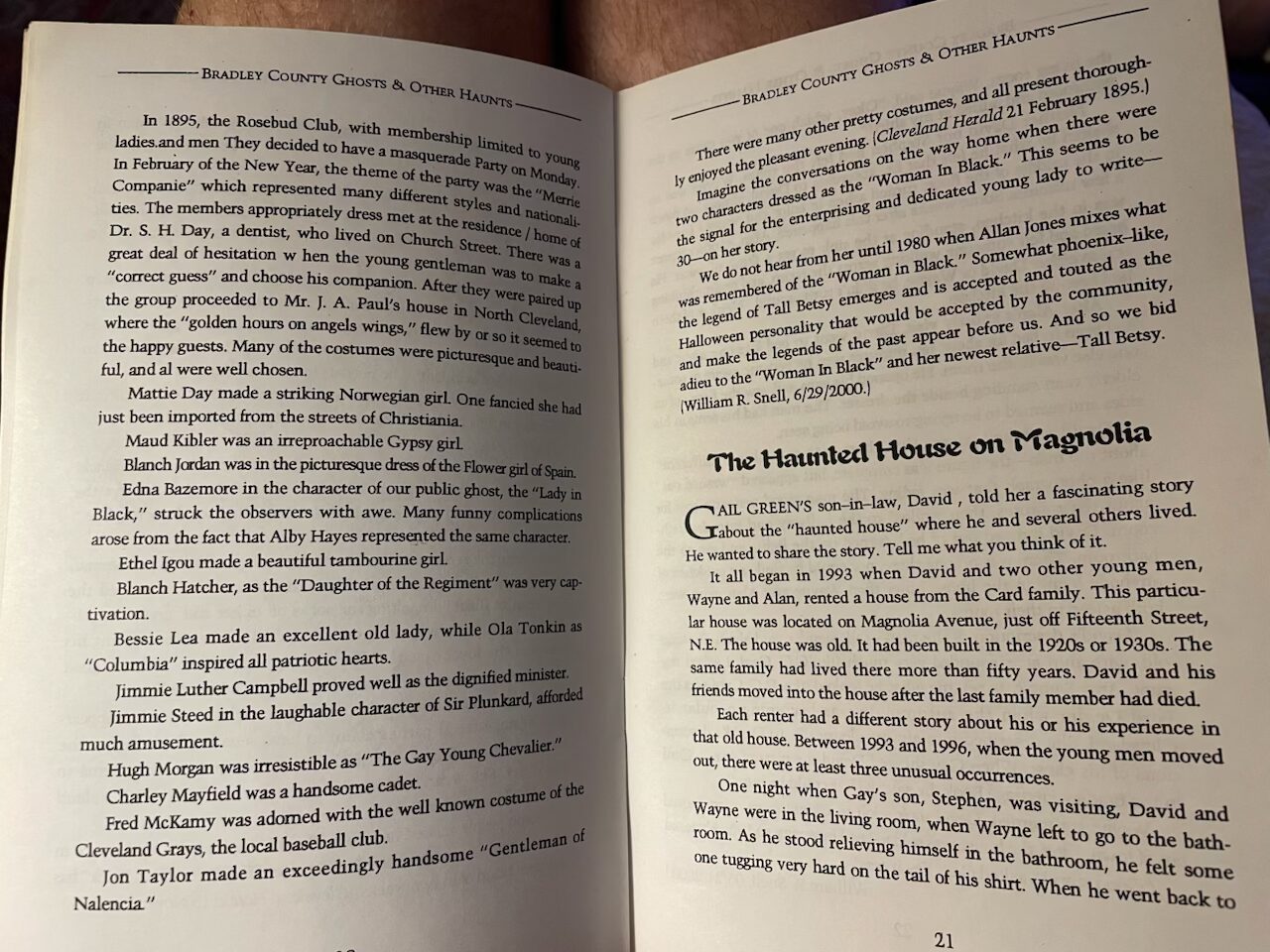
There were many other pretty costumes, and all present thoroughly enjoyed the pleasant evening. (Cleveland Herald 21 February 1895.)
Imagine the conversations on the way home when there were two characters dressed as the “Woman In Black.” This seems to be the signal for this enterprising and dedicated young lady to write—so—on her story.
We do not hear from her until 1980 when Allan Jones mixes what was remembered of the “Woman in Black.” Somewhat tokened as the legend of Tall Betsy emerges and is accepted and protected as the Halloween personality that would be accepted by the community, and make the legends of the past appear before us. And so we bid adieu to the “Woman in Black” and her newest relative—Tall Betsy.
William R. Snell, 6/29/2000